Saturday, March 18, 2023

Of Paddle Ball, Corporations and Fox News


Bap bap bap! When I watch the news, my mind becomes a paddle ball smacking at a ball on a string.  I can't stop ruminating on the injustice of the day. One might think that watching the news would increase my understanding of the world, and I would feel more confident about affecting positive change. Initially, the news does improve my mood, but such gains are ephemeral. In the long run, I end up feeling increasingly bewildered and anxious. Why is that?

Like most people, I seek out news that helps reaffirm my sense that there is much injustice. These news outlets then do just that -- reaffirm my sense that there is much injustice. Then, bap bap bap, my mind is off and ruminating. Clearly, this is dysfunctional. I should engage with both sides of an issue. Right? I should watch news outlets that fully argue perspectives that are the opposite of mine. Right? Its just that simple Right? Well... Its not so simple. Let me explain why. 

For me, the best example of the "other side" would be Fox news.  The problem is that Fox does not represent "the other side" in good faith. The most recent and glaring example of this is Tucker Carlson. Recently, he aired footage of people behaving peacefully in the Capital building. He then stated that this was proof that the Jan 6th insurrection was a lie. Obviously, he has seen the footage of MAGA supporters smashing their way into the capital. He has also seen them injure the capital police and chant "hang Mike Pence." 

People such at Tucker Carlson throw a monkey wrench in the listen-to-both-sides philosophy, because they don't care about reason or evidence. Their goal is not to express what they truly believe. Instead, their goals are to create anger, fear and controversy, which they can then parlay into ratings and wealth. Tucker Carlson is just one person, but he embodies the spirit of our time -- a spirit that is moving away from democratic ideals towards a nihilistic emphasis on obtaining raw power. 

Over the last few decades, power has steadily flowed from the many (the middle class) to the few (the uberwealthy).  In particular, the uberwealthy have steadily increased their ability to direct money from corporations towards supporting most politicians. Naturally, this has left politicians beholden to corporations in order to retain their office and power. As a result, most members of congress advocate for laws that favor corporations and increase their profits. That might be fine, if everyone who worked and invested in the corporations benefited equally from these laws, but this is not the case. 

Primarily, it's the CEO's and other top officials who benefit from these laws. Secondarily, it's the stockholders -- most of whom don't work for the corporations. Lastly, it's the poor and middle class who actually do the work for the corporation. How many times in recent years have corporations laid of the masses to maintain value for the stockholders? How many times have CEO's damaged their companies stock but walked away from their position with a golden parachute? Advocating for "corporate rights" has become code for transferring wealth and power to the uberwealthy.

The tendency for corporations to undermine democracy is tragically under reported. This is unsurprising, because with few exceptions, it is corporations that control the news. This brings me back to Fox news and Tucker Carlson. Recent court filings in the Dominion's lawsuit against Fox revealed how Tucker really felt about the claims of election fraud. In his private text messages, he characterized the idea of voter fraud in the 2020 election as crazy. At the same time, he called for the firing of a Fox news reporter who publicly acknowledged there was no fraud. His concern was that her accurate reporting of the facts might harm Fox's stock. This makes me wonder if Tucker owns significant amount of stock in Fox. Perhaps that might be an interesting subject for another blog. 

I think I will end here and write more on this blog tomorrow -- wherever my mind takes me, For now the paddle ball inside my head is quiet.


Tuesday, October 11, 2022

The Metaphysics of Matter


 Hello all, 


The poem that I wrote last week is included in the body of the material for this week’s blog. I didn’t plan it this way, it’s just how the creative process developed. Anyways… The Metaphysics of Matter starts below. 


Thanks for visiting my blog,


Noah Clawson


 THE METAPHYSICS OF MATTER


Mandelbrot suddenly fell into sullen silence and the glen dimmed into an ashy hue. With foreboding solemnity, he took a deep draw from his pipe and puffed out an opaque globule of smoke. In a span of time that seemed both instantaneous and infinite, Hectic bore witness to the globule expanding into an ever-diversifying universe of wisps. When the wisps had rarefied to such a degree that they became indistinguishable from the ashy hue of the glen, Mandelbrot resumed speaking. At that point, the entire event contained within Mandlebrot's pause in speech vanished from Hectic's mind. He experienced the moment as if Mandelbrot had been speaking continuously and the glen had never dimmed.


"All matter is in motion,” said Mandelbrot. "Therefore, all things affect the things around them." Organisms are things in motion that affect the things around them." 


"Okay," said Hectic, "but that doesn't tell me how life differs from non-life."


Mandelbrot puffed on his pipe and produced a plume of smoke. With his quivering leaves, he shaped the smoke into an opaque gray square. He pointed at the square with one of his branches.

      "Look upon the canvas of smoke and I will show you." he said. "The entire screen filled with the image of a few small speckled eggs clustered in a nest. "I have found," said Mandelbrot, "that life differs from non-life in this respect. All living things use their environment to produce more life forms like themselves. 

      As he was speaking a gray rat jumped into the nest. The rat stood on his hind legs and used his front claws to position the egg with the narrower end facing his mouth. The rat then bit into the end of the egg and began eating the yoke. "This rat will –” 


"I just thought of something," Hectic blurted. Fire must be alive. "Flames breathe the air and eat material from their environment to make more flames." Mandelbrot gasped, and stilled his leaves. His face then fell into a faraway expression as the canvas began to dissipate. Only when the last wisp had rarefied into nothingness, did Mandelbrot begin to speak.  


Life be not that yellow beast

So, Fear the fire's futile feast


He always eats and always starves

Mosaic meals reduced to chars


Thus simplified 

he shrinks and dies


Life ramifies  

then creatures thrive


So complications do exist 

When and where life persists.


      Mandelbrot quivered his leaves and shaped another plume of smoke into a square. Again, he directed Hectic to focus on the canvas of smoke., “Let us start where we left off,”. With a subtle shift of leafy motions, he reconstituted the scene of the rat eating the egg upon the canvas. Those forms only lasted for a few moments before they receded into the grayness of the canvas. Then, new images quickly clarified out of the gray and remained still – like a painting. The canvas depicted a landscape from a cloud’s perspective. Hectic could make out the patchwork of forests, fields and lakes. 

“The canvas shows the creature conflagration,” said Mandelbrot, “but at a scale far slower than you can perceive. I will increase the flow of time within the canvas by a thousandfold. Then, you will see the creature conflagration burning.. Mandelbrot adjusted the angle of his branches and increased the rate at which he was quivering various leaves. A tiny gray globule appeared in the center of the canvas. Every so slowly, the globule began to grow and ruffle around the edges, Soon, other gray globules began to appear. They spread across the canvas, expanded and merged into each other. 

“What is that growing grayness?” asked Hectic.

“That is what happens when just one rat eats like fire.


Thursday, September 29, 2022

Fire's Futile Feast


Image by Gerd Altman by Pixabay

Hi everyone. I have had some personal issues that I had to deal with, so I haven't posted in quite some time. During the last few months, I found four pages that I had originally planned to be in the novel. Somehow, those pages never made it into to the work. Since MANDELBROT THE TREE has an organic, non-linear narrative, the story works well without them. That's why no one noticed they were missing. Having said that, I'm currently working on cleaning those pages up, enhancing them, and adding them to the novel (in a second addition). I think they will add more layers of meaning that will enhance the novel. 

When I finish polishing these missing pages, I will post them on this blog. That way, people who bought the 1st addition can read those pages without buying the book again. I think that is only fair. 

The poem below comes during a section in which Mandelbrot is describing the characteristics of life. Based on what Mandelbrot says, Hectic opines that fire is alive. As Hectic sees it, Fire "breaths" "eats" and "reproduces." Mandelbrot responds to Hectic with the poem -- Fire's Futile Feast. I would be thrilled if folks would comment on the poem. If the poem generates any discussion, I will do a little happy dance. 

Noah A Clawson


FIRE'S   FUTILE   FEAST 


Life be not that yellow beast
So  fear the fire's futile feast

He always eats and always starves
Mosaic meals reduced to chars

Thus simplified 
he shrinks and dies

Life ramifies  
then creatures thrive

So complications do exist 
When and where life does persist

Monday, March 14, 2022

Fifi and Paisley Discuss Current Events and Mandelbrot the Tree

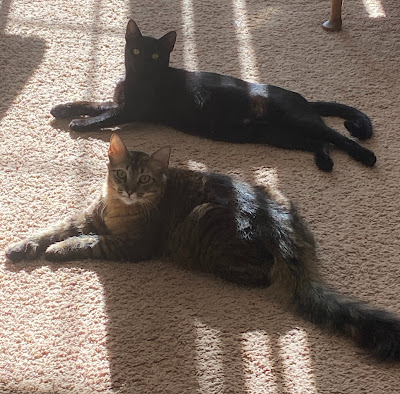
Fifi Cat and Sir Paisley Winterbottom engaged in a heated dialogue


Fifi: I originally wanted to talk about OFFSHOOT 2 -- ENTROPIS, but so much has gone on in the human world that pertains to this book as-a-whole

Paisley: Are you referring to Russia invading Ukraine?

Fifi: Yes, but more specifically the resulting spike in oil prices. That is eerily familiar to the surreal conflation of coffee and oil in Mandelbrot. The book literally describes coffee stations that pump out gallons of coffee from gas pumps. Customers drink gallons of coffee a day to maintain the energy levels they need to function in the Hectic world

Paisley: And then chaos happens in the market and the coffee supplies can't get to the coffee stations. The coffee price triples. In a panic, the customers line up in their cars to get the last drops of "black gold" before it runs out.

Fifi: It's like the Jimmy Carter presidency meets Starbucks... And when the customers can't get their coffee they fall into a "Great Depression."

Paisley: It seems like a fractal way to emphasize an oil addiction, doesn't it? On the individual level, The Noah is talking about people's coffee addiction. On the grander scale, he is communicating something about the human world's oil addiction.

Fifi: The fractal theme is most prominent in the Mandelbrot section. Mandelbrot, as an individual tree, is addicted to oil, or crude as he calls it. Mandelbrot reveals to us that his cells are human beings.

Paisley: The progression of his disease correlates to the problems that oil has inflicted onto humans on a global scale.

Fifi: At the end of the book a solution of sorts grows organically from the dialogue of Hectic and Inchoate. 

Paisley: Let's save that for another blog.


Saturday, March 5, 2022

Fifi and Paisley Discuss the Flow of Time in Mandelbrot


Fifi: The way that time unfolds in Mandelbrot is confusing, and it makes the story line hard to follow. 

Paisley: I didn't have a hard time following the narrative, but I found it impossible to follow the story line. 

Fifi: I don't understand the distinction you're making between story line and narrative. 

Paisley: For me, a storyline implies events unfolding in a linear fashion -- like on a line. When I think of the word storyline, I think of a distinct past, present and future. A narrative, on the other hand, is the way in which the events are portrayed. It's a perspective or philosophy of the word

Fifi: So I guess our Noah is trying to show us that the world is fragmented and chaotic, 

Paisley: The Noah does seem like he is very much interested in Chaos Theory. I suspect, however that his conception of chaos is different than the convention. Fragmented, but in a sense connected at the same time. 

Fifi: This reminds me about a time the Noah was listening to Charles Ives' fourth symphony. He was saying something about different melodies forming layers that drifted into each other. The music to me sounded fragmented, but also part of a greater whole. 

Paisley: Perhaps, it was like a musical lasagna that has had time to age in the refrigerator. There are different layers of ingredients, but their flavors interfuse into each other. They are both separate and together.

Fifi: Perhaps with the narrative in Mandelbrot, the Noah is creating a "time lasagna" so to speak. When I think of it that way, I can imagine different layers of time. 

Paisley: Yes, on one level there is time from the perspective of life on this planet that was emphasized at the very beginning of the story

Fifi: To me, that section seemed more like the development of consciousness, not so much biological life.

Paisley: Maybe those are two interfusing layers.

Fifi: I think there is also time from the perspective of Gregor, the main character

Paisley: He's sort of a main character, but then he transforms into that weird "Hectic Norder." 

Fifi; Yes, as I remember Hectic's body was an amalgamation of many different animal parts fusing into each other. It was almost as if he represented the aspect of interfusing itself.

Paisley: There was also time from the perspective of the development of modernity.

Fifi: I think I understand how this interfusing connects with fractals. Themes from each layer repeat themselves on smaller scales throughout the book. That sounds like a difficult undertaking.


Paisley: I wonder what inspired him to write a book in such a complex manner.


Fifi: Why don't we explore that at another time. 


Sunday, February 27, 2022

Paisely and Fifi commentary on Offshoot One


FiFi: I find this book so confusing. The Author (Noah) does not use chapters to organize his work. Instead, he uses this strange organization of Offshoots, Roots and Rootlets. I don't get it. 

Paisley: I agree that it is weird. However, I happened to be awake when our Noah was discussing this with our Libby. At the time, he had convinced Libby to watch a documentary on something called the Mandelbrot Set. Inherent in the concept of the Mandelbrot Set was the concept Chaos Theory and Fractals. I believe the documentary was called "The Colors of Infinity." 

Fifi What is chaos theory?

Paisley: I don't think I can answer that quite yet, but I'm sure it has something to do with the novel. Getting back to Fractals, they were self-similar shapes in Nature that repeat themselves on different scales of size, The documentary mentioned cauliflower as an example. If you break off a piece of a cauliflower head, that piece will resemble a microversion of the whole. If you then break off a smaller piece from that piece, you get an even smaller microversion of the whole. From what I gathered, this pattern is most iconically represented by the Mandelbrot set. 


Fifi: and what does this have to do with the organization of the book?   


Paisley: I think the Mandelbrot Set inspired the Noah, and he wanted to organize his book in a fractal pattern. The book is called "Mandelbrot the Tree," and it's broken down into Offshoots, Roots and rootlets. 

Fifi: I think The Noah has watched The Colors of Infinity many times before. I think I remember seeing it too. One of the commentators on that documentary described the fractal shape at the heart of the Mandelbrot set as looking like a bug. That reminds me of the scene in the first few pages of the novel when a bug emerges out of the main character's belly button. And, it just occurred to me that the Mandelbrot set is very colorful,

Paisley: That's right! It's like the novel is saying that chaos breeds life or that maybe chaos is life. 

Fifi: Now I'm beginning to get some sense of the Novel's Fractal conception. There are images reminiscent of birth, death, rebirth and evolution repeated on different levels with images that are similar, but not exactly so 

Paisley: Yes, the novel begins with a double-helix image and that image repeats itself in different forms in later pages, 

Fifi: and maybe this concept of fractals might explain why the narrative unfolds in fragmented time.

Paisley: Yes, but let's save our discussion of time for the next blog post. 


Mandelbrot the Tree: Black Gold Blend Coffee

NEWLY ARRIVED! Mandelbrot the Tree: Black Gold Blend coffee by Dean's Beans ! Journey along with Gregor as you read Mandelbrot the Tree:...